Residential Building Performance Analysis
Tools
Revit, Excel, PVWatts
Year
2025
Format
Individual Academic Project
Project Overview
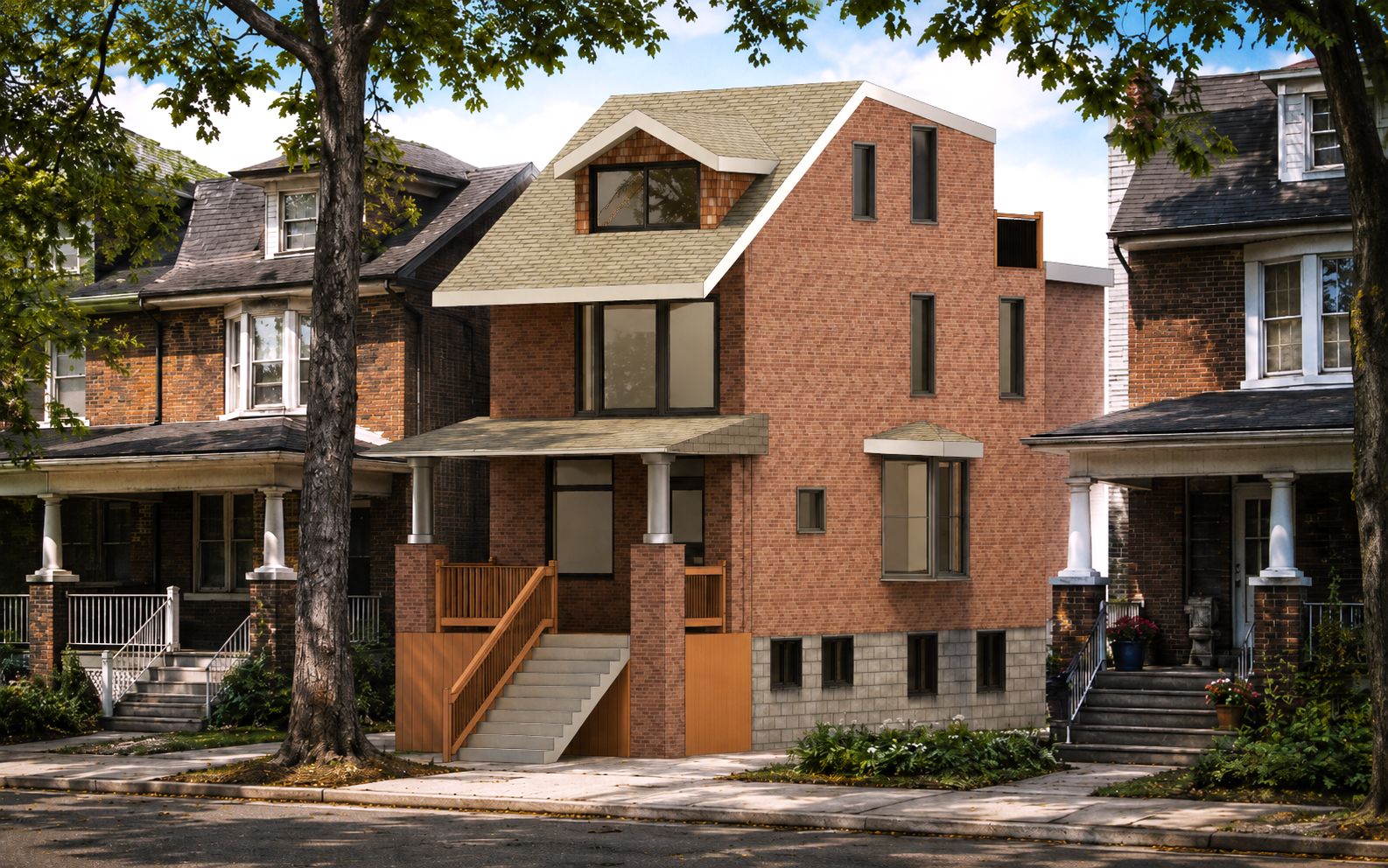
Overview of the existing Toronto residence, 376 Woodbine Ave, used for the building performance study.
Image note: AI-assisted streetscape context appears in this image only. All other work is original.
1 / 6
Project Goal
Assess the environmental performance of an existing residential building through simplified modelling, envelope calculations, energy-use analysis, PV sizing, and rainwater collection estimates.
My Contribution
- Created a simplified Revit model of an existing semi-detached residential building for environmental performance analysis
- Calculated conditioned floor area, building volume, exposed surface area, and window-to-wall ratios using model geometry and Revit schedules
- Estimated envelope thermal performance using R-values, U-factors, infiltration rate, and total heat loss coefficient calculations
- Analyzed annual electricity, natural gas, and water consumption to estimate energy use intensity and resource demand
- Used PVWatts outputs to size a photovoltaic system and evaluate whether available roof area could support net-zero energy goals
- Estimated roof rainwater collection potential and compared available catchment area to annual water demand
Key Features
Existing Plan-Based Model
The Revit model was built using the existing floor plans as a reference, so the layout, levels, room organization, and overall building form reflected the original residence.
Custom Model Elements
Custom and adapted Revit families were imported to make the model more representative of the existing building and improve the final presentation views.
Revit-Based Calculations
Revit schedules and model geometry were used to extract key quantities, reducing the need for fully manual area and surface calculations.